Chiropractic and Your Nervous System: Relief, Then Wellness

Your nervous system runs everything you do: how you move, how you balance, and how loud pain feels. Your spine protects it, and the joints and muscles around your spine are constantly talking to it. That's why I care so much about how your spine moves.
I'm Dr. Jonathan Vincson, DC, and here's how I practice. I meet you where you are, usually in pain. Once you're feeling better, I teach you how your spine, your nervous system and your overall body health are connected, and what you can do every day to keep your body working well.
Schedule an exam · Call (561) 268-2950
Why patients choose Embody: exam-first care · Cox®-certified chiropractor · Saturday hours · 4.9-star Google rating
Key takeaways
- Your spine and nervous system work together to control how you move and how much pain you feel.
- Research shows adjustments change how the nervous system processes pain and controls muscles.
- At Embody, care starts with relief, then I teach you how your spine, nervous system and body health connect.
My approach: relief first, then wellness

Start with relief. Most people come to me because something hurts. We start with a thorough exam, including a neurological screen, then use adjustments, gentle Cox® Flexion-Distraction, soft-tissue work and rehab exercise to calm things down and get you moving.
Then, learn what keeps you well. Feeling better is the start, not the finish. I teach you how your spine and nervous system work together, how that connects to how your whole body feels and moves, and which movements, habits and exercises keep you strong, so you're not just waiting for the next flare-up.
In my practice, I've seen many patients do better than the research alone would predict. They move more freely, stand taller, sleep better and tell me they feel less stressed and more like themselves. I believe better joint motion and a nervous system that isn't stuck on "high alert" are a big part of that. Results are different for everyone, and I'll always be straight with you about what to expect.
How your spine and nerves are connected
- The spine protects the spinal cord, and pairs of spinal nerves exit between the vertebrae at every level.
- Nerves can get irritated where they leave the spine, for example by a herniated or bulging disc, narrowing of the space around the nerve, or swelling after an injury. That's what's behind most pinched nerves in the neck and sciatica. Nerves can also be squeezed farther out, as in carpal tunnel syndrome.
- Pain is processed, not just felt. Your spinal cord and brain can turn pain signals up or down. After an injury, the system can stay "turned up" for a while, so ordinary movement hurts more than it should.
- Movement depends on feedback. Joints and muscles constantly report position and load to the nervous system, which uses that input to coordinate movement and balance.
What we check
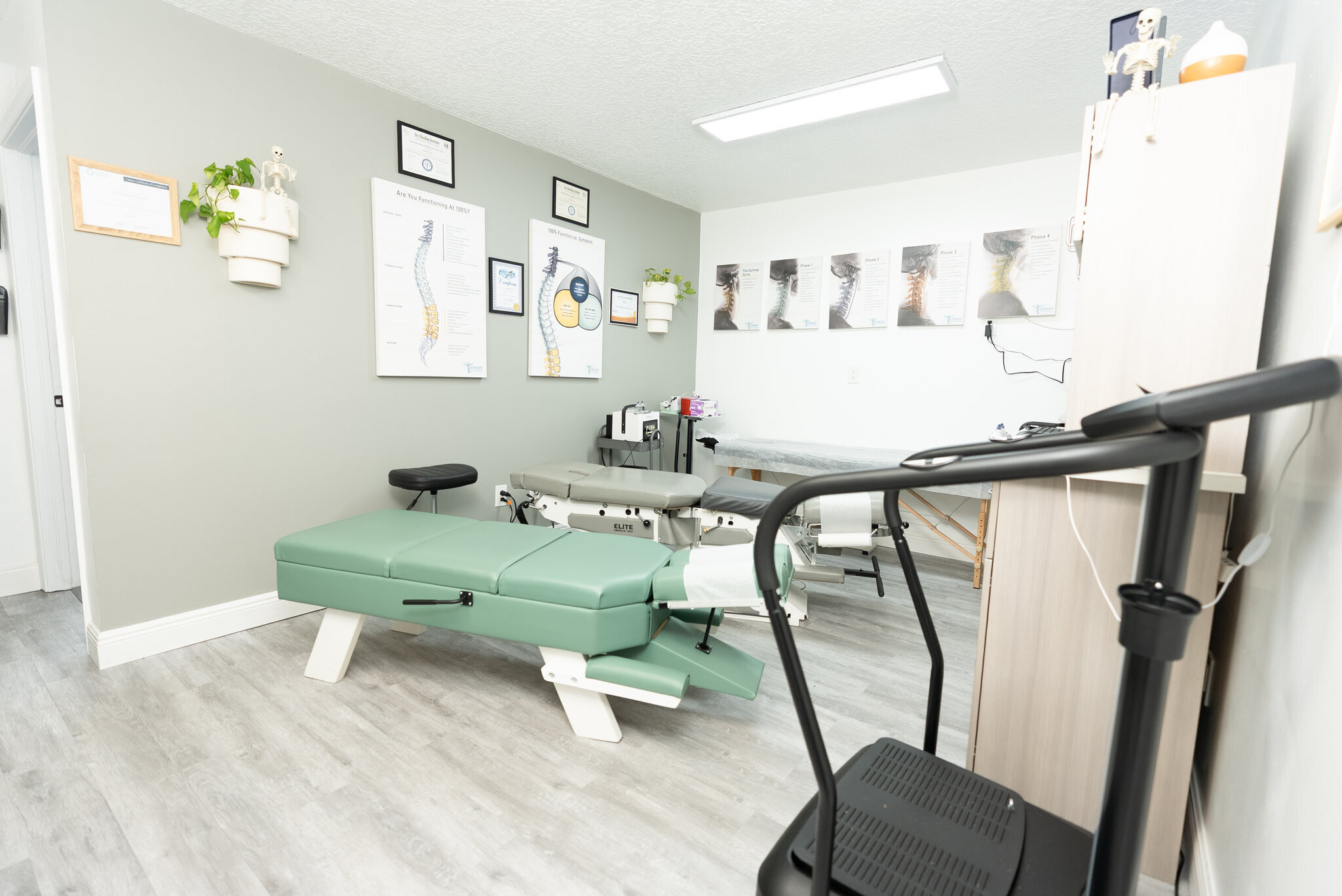
Every new-patient exam includes a neurological screen alongside orthopedic and movement testing:
- Reflexes, sensation and muscle strength in the arms and legs
- Nerve tension tests for pinched-nerve and sciatica patterns
- Balance, coordination and how you move under load
- Red flags that need a physician or imaging, such as progressive weakness, loss of bladder or bowel control, numbness in the groin or saddle area, or symptoms in both legs. If we find one, we refer you right away.
Meet Dr. Vincson
Dr. Jonathan Vincson, DC, is the founder of Embody Wellness Chiropractic in Lantana. He earned his Doctor of Chiropractic at Keiser University College of Chiropractic Medicine and is Cox®-certified, with postgraduate training in FAKTR and dry needling through the American Academy of Manipulative Therapy. Patients rate Embody 4.9 stars on Google. Read more about Dr. Vincson.
What the research supports
Research is still catching up to what many chiropractors see in practice, but the science that exists points in a consistent direction.
Adjustments change how the nervous system processes pain. A meta-analysis of 20 studies found that spinal manipulation raised pressure-pain thresholds more than comparison treatments, including at sites away from the area treated, which points to a central nervous system effect (Coronado 2012). A 2021 review concluded that pain relief from spinal manipulation works at least partly through pain-inhibiting mechanisms in the spinal cord (Gevers-Montoro 2021).
Manual therapy works through the nervous system. A widely cited model proposes that the force of an adjustment sets off a cascade of responses in the peripheral and central nervous system, and that those responses drive much of the result (Bialosky 2009).
Adjustments affect how the brain and muscles communicate. Studies using brain recordings, magnetic brain stimulation and muscle-activity measures have found changes in how the nervous system processes input from the spine and controls muscles after spinal manipulation (Haavik 2012).
Guidelines support chiropractic care for back and neck pain. The American College of Physicians recommends starting low back pain care with non-drug treatments, including spinal manipulation and exercise (Qaseem 2017). Meta-analyses found improvement in pain and function for acute low back pain (Paige 2017) and effects similar to other recommended therapies for chronic low back pain (Rubinstein 2019). For recent neck pain, a multidisciplinary guideline lists manipulation or mobilization combined with exercise as a reasonable option (Côté 2016).
The research is strongest for back pain, neck pain and related problems, and it hasn't shown that adjustments treat other medical conditions, so that's not something I promise (Côté 2021).
Research and sources
The studies below are summarized for general education. Individual results vary, and research findings don't guarantee any specific outcome for you.
- Coronado RA, Gay CW, Bialosky JE, et al. Changes in pain sensitivity following spinal manipulation: a systematic review and meta-analysis. J Electromyogr Kinesiol. 2012;22(5):752-767. PubMed 22296867 · DOI What it found: Spinal manipulation raised pressure-pain thresholds more than other interventions, including at remote sites, supporting a possible central nervous system mechanism.
- Gevers-Montoro C, Provencher B, Descarreaux M, et al. Neurophysiological mechanisms of chiropractic spinal manipulation for spine pain. Eur J Pain. 2021;25(7):1429-1448. PubMed 33786932 · DOI What it found: Spinal manipulation reduces back and neck pain partly through spinal cord mechanisms; other mechanisms still need to be clarified, and better placebo controls are needed.
- Bialosky JE, Bishop MD, Price DD, et al. The mechanisms of manual therapy in the treatment of musculoskeletal pain: a comprehensive model. Man Ther. 2009;14(5):531-538. PubMed 19027342 · DOI What it says: A model in which the mechanical force of manual therapy triggers peripheral and central nervous system responses that drive the clinical result.
- Haavik H, Murphy B. The role of spinal manipulation in addressing disordered sensorimotor integration and altered motor control. J Electromyogr Kinesiol. 2012;22(5):768-776. PubMed 22483612 · DOI What it found: A review of lab studies showing neurophysiological changes in sensory processing and motor output after spinal manipulation.
- Qaseem A, Wilt TJ, McLean RM, Forciea MA. Noninvasive Treatments for Acute, Subacute, and Chronic Low Back Pain: A Clinical Practice Guideline From the American College of Physicians. Ann Intern Med. 2017;166(7):514-530. PubMed 28192789 · DOI What it says: Non-drug treatments first for low back pain, including spinal manipulation and exercise, among others.
- Paige NM, Miake-Lye IM, Booth MS, et al. Association of Spinal Manipulative Therapy With Clinical Benefit and Harm for Acute Low Back Pain: Systematic Review and Meta-analysis. JAMA. 2017;317(14):1451-1460. PubMed 28399251 · DOI What it found: Modest improvements in pain and function for acute low back pain at up to 6 weeks, with transient minor musculoskeletal side effects.
- Rubinstein SM, de Zoete A, van Middelkoop M, et al. Benefits and harms of spinal manipulative therapy for the treatment of chronic low back pain: systematic review and meta-analysis of randomised controlled trials. BMJ. 2019;364:l689. PubMed 30867144 · DOI What it found: Effects similar to other recommended therapies for chronic low back pain.
- Côté P, Wong JJ, Sutton D, et al. Management of neck pain and associated disorders: A clinical practice guideline from the Ontario Protocol for Traffic Injury Management (OPTIMa) Collaboration. Eur Spine J. 2016;25(7):2000-2022. PubMed 26984876 · DOI What it says: For neck pain, rule out serious causes first; for recent neck pain, education combined with exercise or multimodal care (exercise with manipulation or mobilization) may be considered.
- Côté P, Hartvigsen J, Axén I, et al. The global summit on the efficacy and effectiveness of spinal manipulative therapy for the prevention and treatment of non-musculoskeletal disorders: a systematic review of the literature. Chiropr Man Therap. 2021;29(1):8. PubMed 33596925 · DOI What it found: Reviewed research on spinal manipulation for conditions outside the muscles, joints and nerves; good-quality trials did not show a specific effect for those conditions.
More reading: Why spinal health matters for overall wellness.
Nervous system FAQ
Does chiropractic affect the nervous system? Yes. Research shows spinal manipulation can change how the nervous system processes pain and controls muscles. In my practice, I see that in how patients move and feel after care. It's one of the main reasons I pair adjustments with exercise and teaching.
Is chiropractic just for pain? Pain is usually what brings people in, but it doesn't have to be where the conversation ends. Once you're feeling better, I teach you how your spine and nervous system connect to how your whole body feels. Patients often tell us they move more easily, notice better posture, sleep better, feel less stressed and simply feel better day to day. Everyone responds differently, so we track how you're doing at re-exams.
Can a chiropractor help a pinched nerve or sciatica? It may help when the cause is mechanical, such as a disc or joint irritating the nerve. Your exam checks reflexes, strength and sensation to see how the nerve is doing. If you have progressive weakness or other red flags, we refer you for imaging or to a physician.
What is a neurological exam at a chiropractor? It's a check of reflexes, sensation, muscle strength, nerve tension and balance. It shows whether a nerve is involved in your pain and helps me choose the right care, or refer you if you need a different kind of care.
Is spinal manipulation safe? For most people, after a proper exam, yes. The most common side effects are temporary soreness or stiffness. We screen for conditions that need a different approach and use gentler options when they fit better.
Book an exam
Schedule online or call (561) 268-2950. We're at 777 W Lantana Rd, Suite B, Lantana, FL 33462. Hours are Monday–Friday 8 AM–7 PM and Saturday 9 AM–1 PM.
This page is general information, not medical advice. Results vary from person to person. If you have a medical condition, talk with your physician.
